

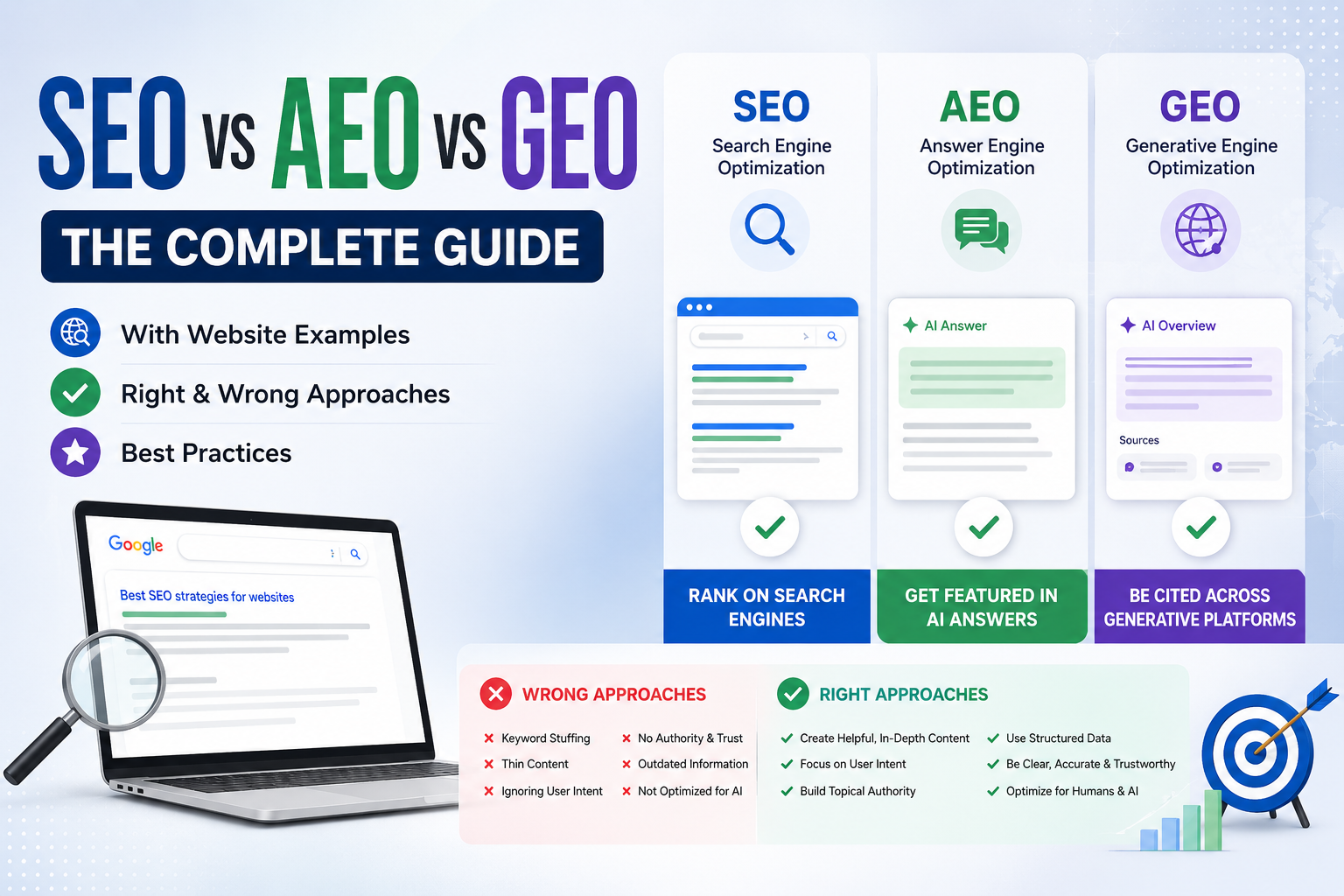
The way people discover businesses online has changed dramatically.
A few years ago, businesses only needed SEO (Search Engine Optimization) to rank on Google. Today, users not only search on Google but also ask questions directly to AI tools like ChatGPT, Gemini, Claude, and Perplexity.
This has introduced two new concepts:
- AEO (Answer Engine Optimization)
- GEO (Generative Engine Optimization)
Many marketers believe these are completely different strategies. In reality, they complement each other.
This guide explains:
- What SEO, AEO, and GEO are
- How they differ
- Website structure examples
- Right and wrong approaches
- Practical examples using a product website
- Whether you should separate SEO, AEO, and GEO into different sections
What is SEO?
SEO (Search Engine Optimization) is the process of optimizing a website so that it ranks higher on search engines like Google and Bing.
Goal
Increase:
- Organic Traffic
- Website Rankings
- Clicks
- Leads
- Sales
Example
A user searches:
Best running shoes for beginners
Google shows a list of websites.
If your website appears on the first page, your SEO strategy is working.
SEO Focus Areas
- Keyword Research
- Technical SEO
- On-page SEO
- Content Optimization
- Internal Linking
- Page Speed
- Mobile Friendliness
- Backlinks
- User Experience
What is AEO?
AEO (Answer Engine Optimization) is the process of creating content that directly answers users’ questions.
Instead of only showing website links, Google now displays:
- Featured Snippets
- AI Overviews
- People Also Ask
- Voice Search Results
Example
User searches:
What is EVA foam?
Google immediately answers:
“EVA foam is a lightweight material commonly used in running shoe midsoles for cushioning and shock absorption.”
The user may never click a website.
That is AEO.
AEO Focus Areas
- FAQs
- Definitions
- Short Answers
- Lists
- Tables
- Step-by-step Guides
- Schema Markup
What is GEO?
GEO (Generative Engine Optimization) is the practice of creating content that AI platforms can understand, trust, and use while generating responses.
Examples include:
- ChatGPT
- Gemini
- Claude
- Perplexity
- Microsoft Copilot
Example
A user asks ChatGPT:
Recommend the best running shoe brands for marathon training.
Instead of returning links, ChatGPT generates an answer based on information from trusted and authoritative sources.
If your website consistently publishes expert, original, and trustworthy content, it has a better chance of influencing those AI-generated responses.
GEO Focus Areas
- Original Research
- Expert Content
- Case Studies
- Statistics
- Author Information
- Brand Authority
- Trust Signals
- Updated Information
- Detailed Product Information
SEO vs AEO vs GEO
| Feature | SEO | AEO | GEO |
| Focus | Search Engines | Answer Engines | AI Models |
| Goal | Website Ranking | Direct Answers | AI Recommendations |
| Users | Google Search | Google AI & Voice Search | ChatGPT, Gemini, Claude |
| Success Metric | Traffic | Answer Visibility | Brand Mentions & AI Citations |
Shoe Website Example
Imagine you own a premium running shoe brand.
A modern homepage could look like this:
- Hero Banner
- Trust & Credibility
- Featured Products
- Shop by Category
- Why Choose Us
- Best Sellers
- Customer Reviews
- Brand Story
- Buying Guide
- FAQs
- Blogs
- Contact Us
- Footer
Each section can be optimized for SEO, AEO, and GEO at the same time.
Homepage Structure with SEO, AEO & GEO
| Section | SEO | AEO | GEO |
| Hero Banner | Primary keyword, H1, CTA | Clear value proposition | Brand expertise, USP |
| Trust & Credibility | Shipping, warranty keywords | Quick facts | Awards, certifications |
| Products | Product keywords | “Who is this product for?” | Technology, materials, testing |
| Categories | Category keywords | Category explanations | Expert recommendations |
| Why Choose Us | Feature keywords | “Why choose us?” | Manufacturing process, expertise |
| Reviews | Review schema | Customer concerns answered | Detailed success stories |
| Brand Story | Company keywords | Company overview | Founder expertise, mission |
| Buying Guide | Informational keywords | Buying advice | Original research |
| FAQs | Long-tail keywords | Direct answers | Expert guidance |
| Blogs | Search intent | How-to articles | Industry insights |
Can We Use SEO, AEO, and GEO in the Same Section?
This is one of the most common questions marketers ask.
Answer: Yes.
You should not create separate content blocks for SEO, AEO, and GEO.
Instead, think of them as three optimization layers applied to the same content.
Wrong Approach ❌
Creating separate sections for each optimization type.
Why Choose Our Shoes
SEO: Premium running shoes for men.
AEO:
Q: Why should I buy these shoes?
A: They are lightweight.
GEO:
We use advanced materials.
Problems:
- Poor user experience
- Repetitive content
- Unnatural writing
- Difficult to read
- Doesn’t provide additional value
Right Approach ✅
Why Choose Our Shoes
Our premium running shoes are designed for comfort, performance, and durability. Built using lightweight EVA cushioning and breathable mesh, they provide excellent support for daily training and marathon running.
✔ Lightweight
✔ Breathable
✔ Shock Absorption
✔ 30-Day Returns
✔ 1-Year Warranty
Frequently Asked Question
Why are these shoes suitable for long-distance running?
Their responsive cushioning, lightweight construction, and breathable upper help reduce fatigue during long runs while maintaining comfort.
What happened?
SEO
- Primary keyword included naturally
- Related keywords included
- Optimized heading
AEO
- Frequently Asked Question
- Direct answer
- Easy for Google AI to extract
GEO
- Product expertise
- Material information
- Trust signals
- Helpful explanation
One section serves all three purposes.
Product Page Example
Product
AirFlex Running Shoes
SEO
- Product Title
- Optimized URL
- Meta Description
- Product Images
- Product Keywords
AEO
Questions:
Is this shoe good for beginners?
Can I use it for the gym?
Is it waterproof?
Each question has a concise answer that search engines can use.
GEO
Include:
- Tested by athletes
- Weight
- Cushion technology
- Best use case
- Material details
- Manufacturing quality
- Customer reviews
AI systems can better understand the product’s strengths.
Homepage Section Examples
Hero Banner
SEO -Premium Running Shoes for Men & Women
AEO -Lightweight running shoes designed for comfort and performance.
GEO -Designed by footwear experts and trusted by thousands of runners.
Trust & Credibility
SEO
- Free Shipping
- Easy Returns
- Secure Payments
AEO
- Free Shipping on Orders Above $50
- 30-Day Returns
GEO
- ISO Certified Manufacturer
- 10+ Years of Experience
- Award-Winning Product Design
Products
SEO
Running Shoes
Walking Shoes
Sports Shoes
Trail Shoes
AEO
Who is this shoe for?
Perfect for beginners and daily runners.
GEO
Include:
- Technology
- Materials
- Testing
- Durability
- Ideal use cases
Why Choose Us
SEO – Use keywords naturally throughout the section.
AEO Answer: Why should customers choose your brand?
GEO
Explain:
- Research
- Manufacturing process
- Sustainability
- Product development
- Expert team
FAQs
SEO – Target long-tail keywords.
AEO – Provide concise answers.
GEO – Include deeper expert guidance and practical recommendations.
Blogs
SEO – Target informational keywords.
Examples:
- Best Running Shoes for Beginners
- How to Choose Running Shoes
- Running Shoe Buying Guide
AEO- Answer common customer questions.
GEO
Publish:
- Original research
- Product comparisons
- Expert opinions
- Industry trends
- Customer case studies
A Simple Content Framework
For every important page or section, ask yourself three questions.
SEO
Can Google rank this page?
Focus on:
- Keywords
- Headings
- Internal links
- Meta tags
- Content quality
AEO – Can Google understand and display this as a direct answer?
Focus on:
- FAQs
- Definitions
- Short answers
- Lists
- Structured content
GEO – Can AI trust this content enough to reference it?
Focus on:
- Expertise
- Original insights
- Research
- Case studies
- Statistics
- Author credibility
- Trust signals
Final Takeaway
SEO, AEO, and GEO are not competing strategies—they work together.
Think of them as three layers of optimization applied to the same content:
- SEO helps search engines discover and rank your pages.
- AEO helps search engines extract concise answers for users.
- GEO helps AI systems understand your expertise and confidently incorporate your information into AI-generated responses.
The best-performing websites don’t create separate “SEO,” “AEO,” and “GEO” sections. Instead, every important page combines all three by using relevant keywords, answering user questions clearly, and demonstrating genuine expertise through original, trustworthy content.
Whether you’re building a product website, a service website, or an eCommerce store, this integrated approach ensures your content is optimized for today’s search engines and tomorrow’s AI-powered discovery platforms.