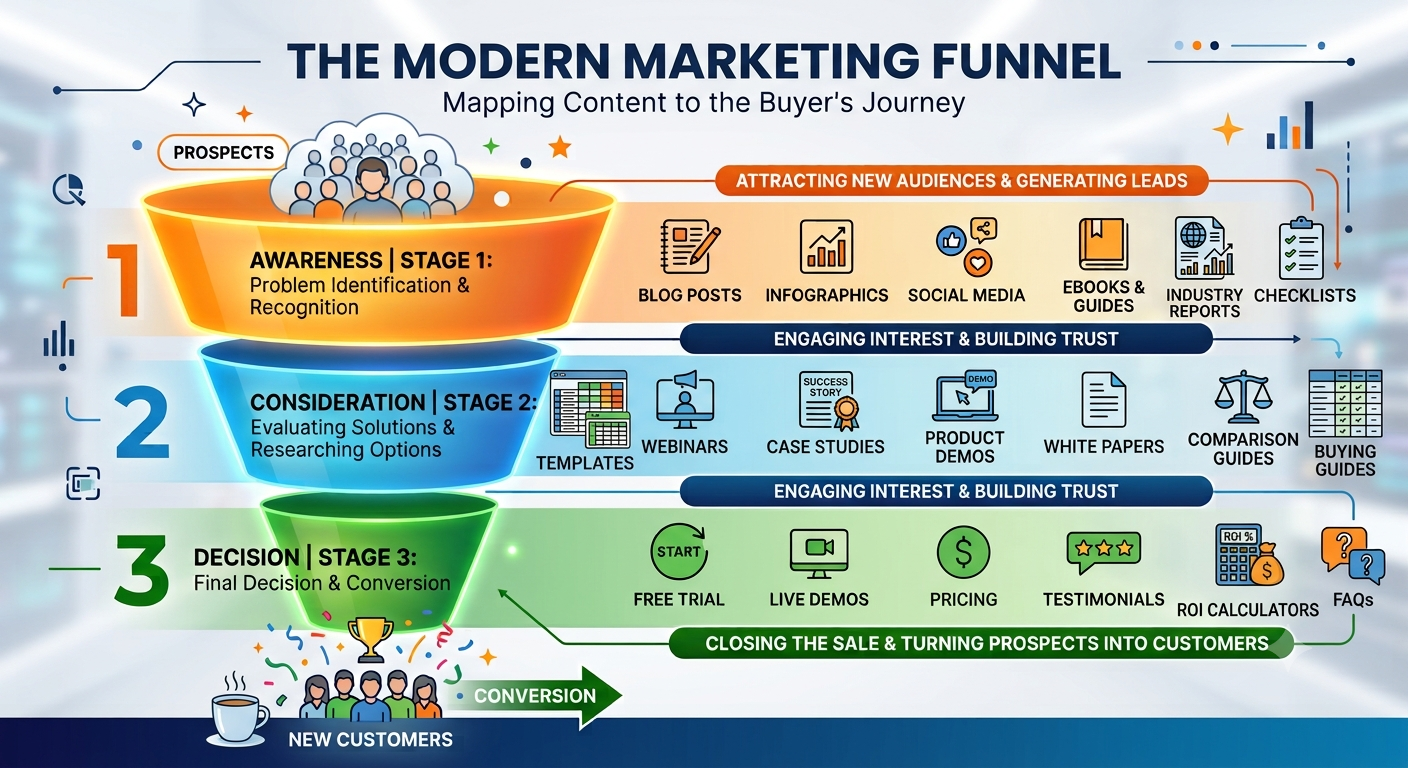
A content funnel audit evaluates whether your existing content supports every stage of the buyer’s journey. By mapping content to the Awareness, Consideration, and Decision stages, you can identify gaps, eliminate redundant assets, and guide prospects toward conversion with the right information at the right time.
Table of Contents
- Introduction
- What Is a Content Funnel Audit?
- Understanding the Three Funnel Stages
- How to Audit Existing Content
- Finding Content Gaps
- Measuring Success
- Best Practices
- Common Mistakes
- FAQ
- Key Takeaways
- Conclusion
- Introduction
A strong content library isn’t valuable simply because it’s large—it must support the customer’s decision-making process. Marketing teams often publish blogs, videos, whitepapers, and case studies without evaluating whether each asset serves a specific stage of the buyer’s journey.
This guide is designed for marketing professionals who want to build an effective content funnel. You’ll learn how to audit existing content, map it to buyer intent, identify missing assets, and create a balanced funnel that supports awareness through purchase.
- What Is a Content Funnel Audit?
A content funnel audit is the process of reviewing and categorizing your content according to where it fits in the customer journey.
Instead of organizing content by format, you organize it by purpose:
Does it educate?
Does it compare solutions?
Does it encourage purchase?
The goal is to ensure prospects always have the information they need to move to the next stage.
Example
A beginner’s guide explains a problem, while a case study demonstrates how your solution solved that problem for a customer.
Practical Insight
Create a spreadsheet with columns for content title, URL, target audience, funnel stage, last updated date, traffic, conversions, and owner.
Image Suggestion
Content inventory spreadsheet.
Filename
content-audit-template.webp
ALT Text
“Spreadsheet used to categorize content by funnel stage.”
Key Point Summary
A content audit reveals whether your existing assets align with the customer journey.
- Understanding the Three Funnel Stages
Awareness Stage
Prospects recognize a problem but may not know the available solutions.
Typical content includes:
Educational blog posts
Industry reports
Infographics
Explainer videos
Checklists
For example, an article titled
“What Is Customer Journey Mapping?” attracts readers researching a topic for the first time.
A related article on Customer Journey Mapping Fundamentals can naturally support this stage.
[Internal Link: Customer Journey Mapping Guide]
Key Point Summary
Focus on educating rather than selling.
Consideration Stage
At this point, prospects understand their problem and begin evaluating different approaches.
Useful content includes:
Buying guides
Webinars
Comparison articles
Expert interviews
Templates
For example, “CRM vs Spreadsheet: Which Is Better for Sales Teams?” helps readers compare solutions objectively.
Supporting resources such as a Marketing Automation Guide can deepen their evaluation.
[Internal Link: Marketing Automation Guide]
Key Point Summary
Help buyers compare options with objective information.
Decision Stage
Prospects are ready to choose a solution.
Content should reduce uncertainty and reinforce trust.
Examples include:
Product demos
Case studies
Customer success stories
Pricing pages
FAQs
ROI calculators
A detailed case study showing measurable business outcomes often provides the confidence needed to make a purchase decision.
[Internal Link: Case Study Framework]
Key Point Summary
Decision-stage content should answer final questions and reinforce credibility.
- How to Audit Existing Content
Follow these steps:
- Inventory Every Asset
List all blogs, landing pages, videos, webinars, whitepapers, emails, and downloadable resources.
- Assign a Funnel Stage
Determine whether each asset primarily serves Awareness, Consideration, or Decision.
- Evaluate Performance
Review metrics such as:
Organic traffic
Engagement
Time on page
Leads generated
Assisted conversions
- Remove or Improve Weak Content
Outdated, duplicated, or low-performing content should be updated, consolidated, or retired.
- Prioritize High-Impact Opportunities
Address gaps where prospects lack the information needed to move forward.
Practical Insight
Content often performs better after being repositioned to the correct funnel stage rather than being rewritten from scratch.
Key Point Summary
An effective audit combines content classification with performance analysis.
- Finding Content Gaps
After mapping your assets, patterns become easier to identify.
Common gaps include:
Many educational blogs but no case studies
Strong comparison content but weak product demonstrations
Few resources answering post-purchase questions
Missing industry-specific examples
A balanced funnel supports users from discovery through decision.
For additional planning techniques, see Editorial Calendar Planning and Content Strategy Framework.
[Internal Link: Editorial Calendar Guide]
[Internal Link: Content Strategy Framework]
Image Suggestion
Three-column content map showing assets across funnel stages.
Filename
content-funnel-map.webp
ALT Text
“Content assets organized by awareness, consideration, and decision stages.”
Key Point Summary
Content gaps reveal where prospects may leave the buying journey.
- Measuring Success
Track metrics that align with each stage.
Funnel Stage | Example Metrics |
Awareness | Organic traffic, impressions, new users |
Consideration | Downloads, webinar registrations, email sign-ups |
Decision | Demo requests, qualified leads, conversions, revenue |
Review these metrics regularly to determine whether content is moving audiences through the funnel rather than attracting traffic alone.
Key Point Summary
Success is measured by progression through the funnel, not just page views.
- Best Practices
Define the target audience before creating content.
Assign one primary funnel stage to each asset.
Update high-performing evergreen content regularly.
Use consistent messaging across channels.
Link related content to guide readers naturally between funnel stages.
Review your content inventory at least twice a year.
- Common Mistakes
Creating only top-of-funnel blog posts.
Treating every page as a sales page.
Ignoring outdated content.
Publishing without measurable objectives.
Failing to connect related content with internal links.
Measuring success using traffic alone.
- Frequently Asked Questions
What is a content funnel audit?
It is the process of reviewing and categorizing content according to the stages of the buyer’s journey.
How often should I perform a content audit?
Most organizations benefit from a comprehensive audit every six to twelve months.
Can one article fit multiple funnel stages?
Yes, but each asset should have one primary purpose to maintain clarity and support accurate performance measurement.
What tools help with a content audit?
Spreadsheets, Google Analytics, Google Search Console, content management systems, and SEO platforms can all support the process.
Why is funnel mapping important?
It helps ensure buyers receive relevant information throughout their decision-making journey, improving engagement and conversions.
- Key Takeaways
Audit every content asset before creating new material.
Map each asset to Awareness, Consideration, or Decision.
Identify gaps that interrupt the customer journey.
Measure performance using stage-specific metrics.
Strengthen internal linking between related content.
Update and repurpose valuable content regularly.
- Conclusion
A content funnel audit provides a structured way to evaluate whether your content supports the entire customer journey. By mapping each asset to the Awareness, Consideration, and Decision stages, marketing teams can identify gaps, improve content effectiveness, and create smoother paths toward conversion. Make funnel audits a recurring part of your content strategy to keep your library aligned with evolving customer needs and business goals.